
Do Office Pods Need Ventilation? Industry Standards & Research-Backed Answers
Modern workplace design has rapidly embraced office pods, acoustic booths, and modular private workspaces to solve the distractions of open-plan offices. These enclosed structures deliver exceptional sound insulation, privacy for confidential calls, and dedicated zones for deep work - but their fully sealed, compact construction creates a critical design challenge: airflow renewal. This raises a core question for facility managers, interior designers, and workplace specifiers: Do office pods really need dedicated mechanical ventilation?
The answer, backed by global industry standards, independent academic research, and real-world product performance data, is definitive: Proper mechanical ventilation is not an optional upgrade for office pods - it is a fundamental, health-critical requirement.
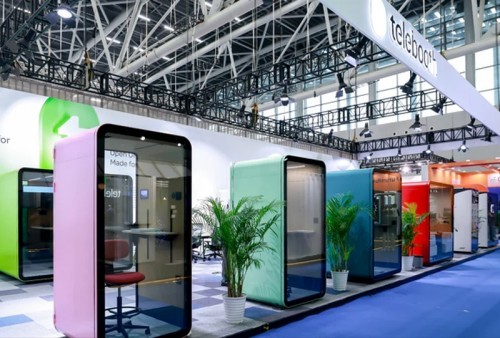
Multiple independent studies have verified the risks of unventilated office pods. A 2025 MDPI study on partitioned office ventilation further confirms that standard enclosed pods with 2.6m ceiling heights - the most common specification for commercial office pods - suffer the poorest air circulation. Even short-term occupancy of one to two hours pushes internal CO₂ concentrations to 1,200–1,600 ppm, far exceeding healthy workplace thresholds.
Elevated CO₂ levels directly undermine the core purpose of office pods: boosting focus and productivity. Research from the Harvard T.H. Chan School of Public Health confirms that sustained CO₂ levels above 1,200 ppm reduce cognitive performance by 10–20% and increase decision-making error rates by up to 25%. What is designed to create distraction-free work zones instead becomes a space that induces drowsiness, brain fog, and reduced work efficiency - completely negating the value of acoustic privacy.
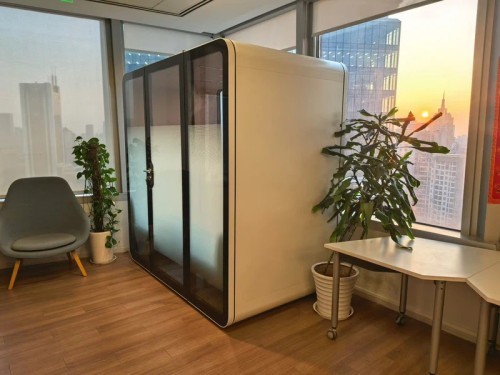
Beyond impaired productivity, inadequate ventilation introduces long-term health and hygiene risks. Low-VOC acoustic panel materials, while environmentally compliant, continuously release trace volatile organic compounds (VOCs) that cannot dissipate without active airflow renewal. Over time, accumulated VOCs and humid, stale air compromises indoor air quality, fails to meet global workplace health benchmarks, and creates uncomfortable, unsustainable working conditions for long-duration use.
Telebooth has published ventilation performance data for its full standard product line.
Notably, the single-occupancy TB-S model delivers 95 ACH, while the full product line maintains a minimum of 70 ACH across all multi-occupancy configurations. This precision-engineered ventilation system ensures consistent fresh air renewal, stable internal temperature, and minimal stuffiness even during all-day continuous use.
Premium office pod design therefore relies on a balanced engineering approach: robust sound insulation for quiet privacy paired with low-noise, high-efficiency mechanical ventilation for continuous fresh air circulation. Well-engineered ventilation systems eliminate stuffiness, stabilize internal temperature, dilute CO₂ and residual VOCs.
Key Research & Standard References
1.MDPI Sustainability (2025): Enclosed pod structure severely limits passive air circulation and accelerates air quality degradation
2.Harvard T.H. Chan School of Public Health (2023): Elevated CO₂ reduces workplace productivity and cognitive accuracy
3.AIVC Industry Report (2020): Passive airflow is ineffective for fully enclosed modular office pods

Get real-time quotes
Interested? Leave your contact details.