
Budgeting for Phone Booths for Offices: Costs Beyond the Purchase Price
Budgeting for Phone Booths for Offices: Costs Beyond the Purchase Price
When a request for phone booths for offices reaches the finance desk, the first question is usually straightforward: “What does each unit cost?” It is a sensible starting point, but rarely the number that determines whether the investment performs well over time.
A workplace booth is not simply a piece of furniture. It is a compact, powered, ventilated acoustic environment placed inside a live office. Its value depends on how easily it can be deployed, how consistently employees use it, whether it avoids creating new facilities problems, and whether it remains useful as the workplace changes. For finance decision-makers, the more useful lens is total cost of ownership—not the headline quotation alone.
The goal is not to buy the least expensive pod. It is to fund a solution that reduces avoidable disruption, supports confidential calls and hybrid meetings, and uses valuable floor space responsibly.
Start with the real business requirement, not the product category
“We need booths” can describe several very different needs. A sales team may need quiet spaces for customer calls. HR may need privacy for sensitive conversations. A hybrid office may be struggling with video meetings taking place at open desks. Leadership may want small meeting spaces without committing to permanent construction.
Each use case affects the right mix of size, acoustic performance, internal equipment, and quantity. A one-person call booth may be sufficient for focused work, while a compact two-person pod can serve quick manager check-ins, interviews, or collaborative calls. Buying larger units “just in case” can inflate both acquisition and real-estate costs. Conversely, under-sizing the program can lead to queues, low satisfaction, and a second purchase sooner than expected.
Before comparing suppliers, ask operational leaders to estimate peak demand: How many simultaneous private calls occur during busy hours? Which teams require speech privacy? Are booths intended for 15-minute calls, half-day focus sessions, or short two-person meetings? These answers turn a broad workplace amenity into a budgetable capacity plan.
The purchase price is only the first line of the budget
A robust business case for phone booths for offices should separate one-time deployment costs from recurring operating costs. This avoids the common mistake of approving a low initial quote and discovering later that delivery, site work, or relocation has been treated as an exception.
- Product configuration: Base structure, glazing, desk, seating, power outlets, occupancy indicators, digital controls, and finish selections can all change the quoted price.
- Freight and delivery access: A booth may need to pass through loading bays, lifts, corridors, and doorways. Restricted delivery hours, multiple floors, or difficult access can add handling costs.
- Assembly and positioning: Modular booths need professional installation, levelling, and final functional checks. Clarify whether assembly, packaging removal, and placement are included.
- Electrical readiness: Most office pods require a nearby power source. The cost may be minimal in a well-serviced floorplate, or more substantial where outlets must be added or circuits reviewed.
- Building approvals: Landlord, facilities, fire-safety, and property-management requirements can affect timing and documentation needs, particularly in shared or premium office buildings.
- Ongoing care: Cleaning, replacement components, filter or fan servicing where applicable, repairs, and warranty administration should be considered over the expected use period.
None of these items is necessarily a reason to delay a project. They simply need a named owner and a realistic allowance. Finance teams are often most successful when they request a “delivered and operational” budget rather than comparing ex-works product prices.
Acoustic performance should be assessed as a risk-control item
Noise reduction is often discussed in broad marketing terms, yet its financial implications are practical. If users can still hear confidential content from outside the booth, employees may avoid using it for HR conversations, client calls, legal discussions, or financial reviews. If exterior office noise leaks into the enclosure, call quality and concentration suffer. In either case, a lower-cost unit can become an underused asset.
Request the test basis behind acoustic claims and ensure the reported figure is relevant to the installed product. Details such as door seals, glass construction, wall composition, ventilation paths, and assembly quality affect real-world results. It is also wise to distinguish between reducing surrounding noise and delivering complete confidentiality; no small enclosure should be represented as eliminating every sound in every environment.
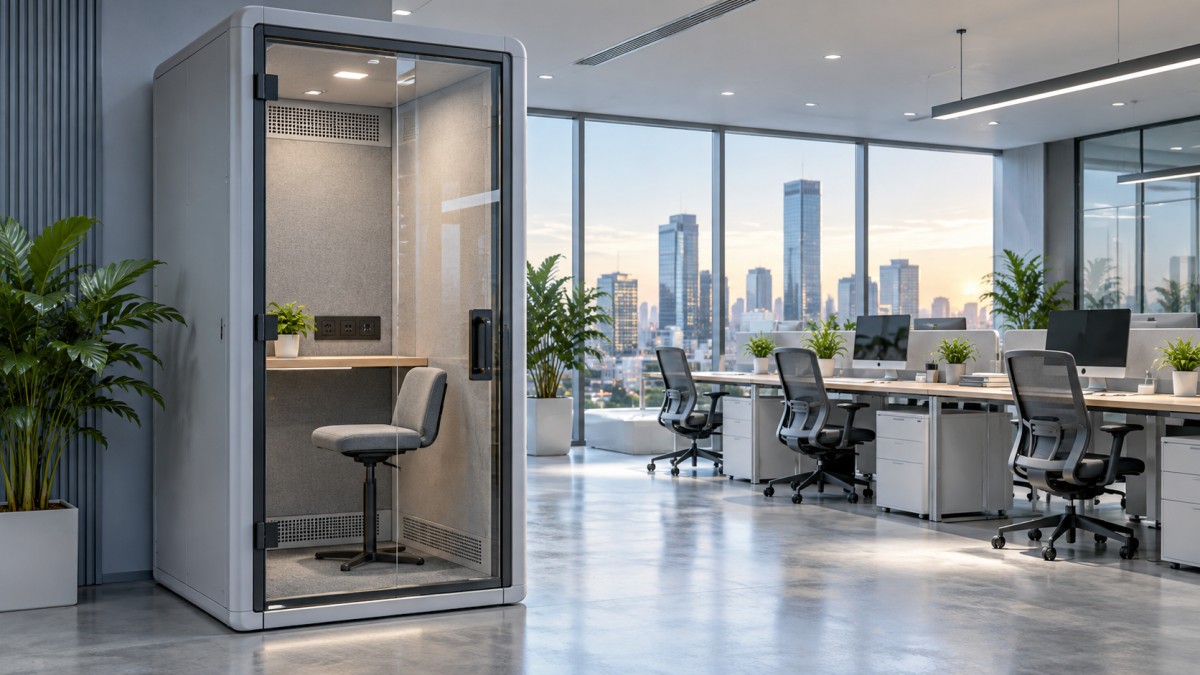
For example, the TB-W Office Pod 1-2 Person is designed for focused work and short meetings, with reported noise reduction of 28–31 dB supported by SGS or Chinese Academy of Sciences Acoustics Institute test reporting. Its steel frame, sound-insulating materials, sound-absorbing panels, laminated glass, and sealed construction should be evaluated as a system rather than as isolated material specifications.
Ventilation and power consumption deserve a closer look
A booth that feels stuffy after a few minutes will not achieve the utilization assumed in the business case. Ventilation is therefore more than a comfort feature: it protects adoption. Ask how airflow is managed, how quickly the interior air is refreshed, whether fan speed can be adjusted, and whether the system responds to occupancy rather than running at full output all day.
Energy cost is usually modest compared with the cost of unused office space, but it still belongs in the review. Efficient lighting, presence sensors, standby settings, and sensible ventilation controls can reduce unnecessary consumption across a fleet of booths. They also make the user experience feel less improvised.
In the TB-W configuration, maximum power consumption is listed at 30W, with 5W standby consumption. Motion-activated ventilation, lighting controls, and a maximum airflow of 180 m³/h are examples of specifications that help facilities and finance teams model operational requirements. The booth’s stated 35-second full air-change time is useful context, but should be reviewed alongside the intended occupancy pattern and local building conditions.
Floor space has a carrying cost, even when it does not appear on the invoice
Every square metre allocated to a booth is space that cannot be used for desks, circulation, storage, or informal collaboration. That does not mean booths are space-inefficient. In many offices, they can be a more flexible alternative to building small permanent rooms, especially when demand for enclosed space changes frequently.
The important question is whether the footprint matches actual demand. A compact 1–2 person unit with external dimensions around W1500 mm × D1320 mm × H2300 mm may fit into underused perimeter areas or open-plan zones, but placement still requires consideration of circulation paths, sprinkler clearance, emergency routes, accessibility, and visual impact. Facilities should validate the proposed layout before a purchase order is issued—not after delivery is scheduled.
Build flexibility into the approval
Office layouts evolve. Teams grow, leases change, and hybrid policies are revised. This is where modular phone booths for offices can offer a different financial profile from fixed construction. A relocatable unit may retain utility through a move, a departmental reconfiguration, or a change in work patterns. But “relocatable” is not the same as “free to move.” Budget for disassembly, transport, reinstallation, and possible site adjustments when evaluating lifecycle value.
Ask suppliers what happens if a component is damaged, a power specification changes, or the booth needs to be moved to another office. Availability of replacement parts, lead times, warranty terms, and after-sales support can matter more than a small saving on the original order.
A practical approval checklist for finance teams
Before approving the project, confirm that the request answers these questions clearly:
- What specific work activity will the booths support, and how many users are expected at peak times?
- What is included in the supplier’s quote, and what remains with the customer or building manager?
- Have delivery access, lift capacity, electrical connections, and placement constraints been checked?
- Is acoustic performance supported by credible testing or documentation?
- Will ventilation, lighting, seating, and charging support the intended length of use?
- What are the expected maintenance, warranty, repair, and relocation costs?
- How will utilization and employee feedback be reviewed after installation?
A pilot can be especially valuable when demand is uncertain. Installing a limited number of units, tracking booking or occupancy patterns, and gathering feedback from frequent callers can reveal whether the organization needs more single-person booths, more collaborative pods, or a different placement strategy. That evidence makes a broader rollout easier to defend.
The better budget is the one that protects adoption
For financial approvers, the strongest proposal is not the cheapest line item; it is the one that connects cost to sustained workplace use. Well-specified booths can reduce the friction of open-plan work, give employees a dignified place for private conversations, and relieve pressure on enclosed meeting rooms. Poorly planned units can become expensive furniture.
By accounting for installation, acoustics, ventilation, energy, floor space, serviceability, and future mobility from the outset, organizations can evaluate phone booths for offices with fewer surprises—and make a decision that remains credible long after the initial invoice has been paid.

Get real-time quotes
Interested? Leave your contact details.