
Office Phone Booths Explained: Key Components That Create a Quiet Call Space
Office phone booths work when they solve two problems at once: they reduce the distraction around a caller and make speech less intelligible to people outside. A quiet-looking enclosure does not automatically do either. The result depends on how its walls, glass, door seals, ventilation, power, lighting, and interior surfaces work together.
For employees in open-plan offices, the practical benefit is simple: a video meeting, customer call, interview, or sensitive conversation can take place without competing with nearby conversations. For workplace planners, the harder question is whether a booth will remain comfortable and useful after repeated daily use. The components below provide a more reliable way to assess that.
Sound control is more than a thick wall
A well-designed call booth uses two related but different acoustic strategies: sound insulation and sound absorption. Sound insulation limits transmission through the booth structure. Sound-absorbing finishes reduce reflections within the enclosure, so the user hears less echo and their microphone captures clearer speech.
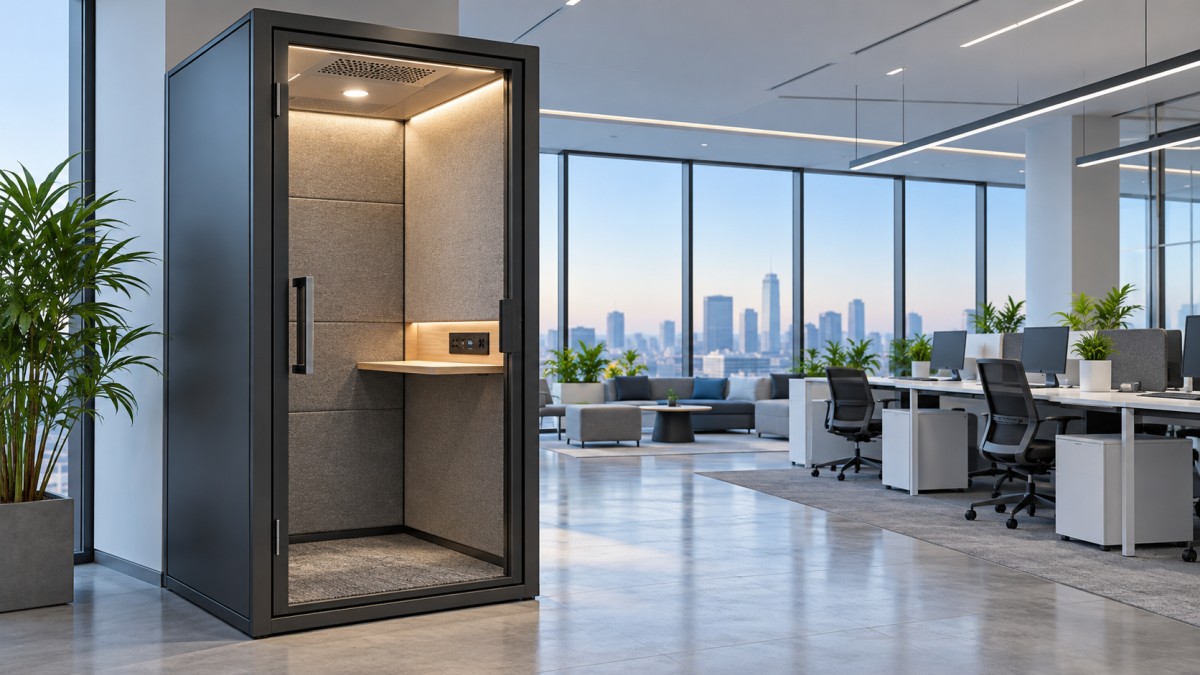
The outer shell commonly combines a rigid frame with layered panels, insulation, and acoustic linings. Glass needs the same attention as solid walls. Large, single-pane glazing can become a weak point; laminated acoustic glass is often used because its interlayer helps damp vibration while preserving visibility and daylight.
Absorption inside the booth matters for call quality. Hard surfaces such as glass, metal, and untreated panels reflect sound. Carpet, fabric-covered acoustic boards, upholstered seating, and other porous finishes reduce those reflections. This does not make the booth “soundproof” by itself, but it helps prevent the boxy, echoing sound that makes long calls tiring.
The door is frequently the most overlooked part. A heavy acoustic door with poor seals can leak sound around its perimeter. Check how the door closes, whether seals meet consistently, and whether the threshold creates an obvious gap. Acoustic performance is only as strong as the weakest continuous opening.
Ventilation has to be quiet as well as effective
A sealed-feeling booth is uncomfortable within minutes unless fresh air is replaced continuously. Yet every air path is also a potential route for sound to travel. Effective office phone booths use acoustically treated intake and exhaust paths so air can move without creating a direct opening between the inside and outside.
Air volume alone is not the whole answer. Fan noise, airflow direction, and control logic affect the experience. A loud fan can be as distracting on a call as nearby office chatter. Systems that increase ventilation when the booth is occupied and reduce it in standby can support comfort while avoiding unnecessary energy use, provided the operating noise stays restrained.
For example, the TB-ML 3000 Multiple Person Office Pod uses six fresh-air units and a ceiling motion sensor that activates lighting and ventilation when occupants enter. Its stated maximum ventilation capacity is 1080 m³/h. The larger point for buyers is not the number alone: assess whether ventilation remains comfortable at full occupancy, especially when several people are speaking in a closed room.
The call setup determines whether people will actually use it
People do not enter a booth merely to find silence. They bring a laptop, headset, charger, notebook, and often a coffee. A usable setup needs a stable work surface at an appropriate height, accessible power, and enough room to sit or stand without putting the camera at an awkward angle.
Power should be available where the user naturally works, rather than behind furniture or at floor level. A mix of mains outlets and USB charging is useful because meeting users often arrive with different devices. Cable routing also deserves attention: loose leads across the entrance are both untidy and a trip hazard.
Lighting changes how professional a person appears on camera. A ceiling light directly above the user can create shadows under the eyes, while a very cool light can make video images look harsh. Dimmable lighting with adjustable colour temperature gives users a better chance of adapting the booth for focused work, video calls, or informal meetings. It should illuminate the face and tabletop without shining into the user’s eyes or reflecting strongly in the glass.
Occupancy signals prevent a common shared-space problem
A booth can offer excellent privacy and still frustrate employees if nobody knows whether it is free. A clear occupied/vacant indicator reduces door checks and interruptions. It is particularly helpful in offices where booths sit in busy circulation areas or are used for scheduled interviews and client calls.
Sensor-controlled lighting also has a practical role beyond energy saving. It gives the user an immediate visual cue that the booth is active and avoids lights being left on after use. The timing should suit the workplace: a very short delay can be irritating if someone briefly steps out to collect a laptop, while an excessively long delay wastes power.
Match the booth size to the conversation, not the floor plan alone
Single-person booths are efficient for short calls, concentration work, and private video meetings. They are not a substitute for every meeting room. Two or more people need sufficient elbow room, seating, table depth, and ventilation; otherwise, they will continue booking conventional rooms.
A multi-person pod may be appropriate when a team needs a contained place for focused collaboration rather than only individual calls. The TB-ML 3000, for instance, has internal dimensions of 2250 mm by 2900 mm and a workstation table intended for several users. Its 28-30 dB stated noise reduction can be a useful reference point, but the decision should still consider the surrounding office noise, the confidentiality of conversations, and how the booth will be positioned.
Placement can weaken an otherwise good booth
Office phone booths should not be placed where people queue directly beside the door, where a coffee machine creates constant noise, or where the glass faces a high-traffic route. The enclosure controls airborne sound, but it cannot erase the visual distraction of colleagues passing close by.
Allow space for the door swing, cleaning access, electrical connection, and airflow around the unit. A booth near desks can be convenient, but it should not block evacuation routes or create a bottleneck in a narrow aisle. In a larger layout, placing several booths near shared work zones can reduce the distance users travel while keeping call activity away from quiet desk areas.
What to check before choosing a model
- Test the experience with realistic noise: listen from both inside and outside while someone speaks at a normal call volume.
- Inspect joints, door seals, and ventilation paths: these details often affect privacy more than a visually impressive wall panel.
- Try a real video call: check echo, fan noise, facial lighting, screen glare, and Wi-Fi or network access.
- Measure the installation route: lift dimensions, doorways, ceiling clearances, and final positioning can determine whether a modular unit is practical.
- Define the intended users: a booth selected for one person will be judged poorly if it becomes the default space for pairs or small teams.
The most effective acoustic spaces are selected as part of a workplace workflow, not as isolated furniture. Once the expected call length, privacy level, occupancy, and location are clear, it becomes much easier to decide whether a compact phone booth, a focus pod, or a larger enclosed meeting space is the right fit.

Get real-time quotes
Interested? Leave your contact details.