
Single vs. Dual Phone Booths for Offices: Which Configuration Makes Sense?
Choosing between single and dual phone booths for offices is usually less about which unit looks better and more about how work actually happens during a busy day. A single booth is often the stronger choice when employees mainly need a quiet place for private calls, focused video meetings, or short concentration sessions. A dual booth makes more sense when two people regularly need to join calls together, conduct one-to-one discussions, or review work without occupying a larger meeting room.
The practical decision comes down to call patterns, not headcount alone. A 40-person office with mostly independent client calls may gain more from several single-person booths than from one dual unit. By contrast, a smaller team with frequent manager check-ins, interview calls, or paired support work may find that a dual booth prevents small conversations from spilling into open work areas.
Start with the conversation that needs a room
Open-plan offices often reveal the issue at predictable moments: a sales representative takes a sensitive client call, a manager needs to discuss performance privately, or two colleagues try to join the same video meeting from their desks. Background speech then becomes disruptive in two directions. The callers struggle to hear, while surrounding employees lose focus.
Before comparing footprints or finishes, identify the most common acoustic interruption in the workplace. The answer generally points to the right configuration.
A useful distinction is between two people having separate calls and two people participating in one conversation. A dual booth solves the second situation. It does not efficiently solve the first, because separate calls inside the same enclosure can interfere with each other and create an awkward user experience.
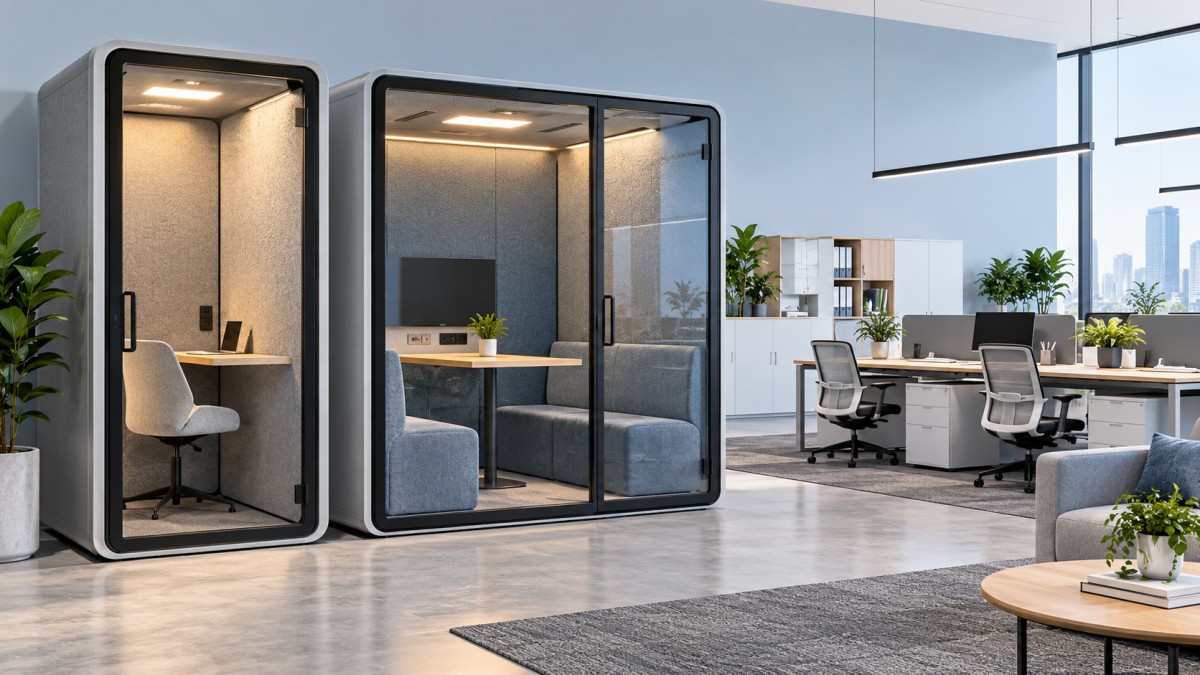
Where single phone booths perform best
Single phone booths are built around immediacy. An employee can step in for a confidential call, connect to a video meeting, or complete focused work away from nearby conversation. This makes them particularly effective in offices where calls are short, frequent, and independently scheduled.
From a layout perspective, single units can be easier to distribute near active teams. Placing one close to sales, customer service, human resources, or shared workstations may reduce the distance employees need to travel when a call arrives unexpectedly. Distributed placement can also prevent a single “quiet zone” from becoming congested at certain times of day.
They are not automatically the lower-cost decision in every project. When an office needs several private call spaces, the combined footprint, power planning, ventilation needs, and circulation space around multiple single booths should be assessed together. A small booth placed too close to desks, doors, or a high-traffic route may still create operational friction even if its internal acoustics are effective.
Single booths are usually the better fit when:
- Most calls involve one employee and an external participant.
- Privacy demand occurs throughout the day rather than in scheduled blocks.
- Employees need an alternative to taking calls in corridors, stairwells, or vacant meeting rooms.
- Available floor area is fragmented across the office rather than concentrated in one large open zone.
- The business wants to preserve larger meeting rooms for group collaboration.
When a dual booth is the more efficient choice
A dual booth earns its space when it replaces informal conversations that would otherwise occur at desks or in oversized meeting rooms. Think of a hiring manager and recruiter joining an interview call, a team lead coaching an employee, or two colleagues reviewing a presentation before a client meeting. These are not large-group sessions, but they still require speech privacy, visual privacy, and enough room to sit comfortably.
The key benefit is not simply adding a second chair. It is providing a controlled setting for a shared task. That requires adequate internal dimensions, seating arrangement, table access, lighting, airflow, and acoustic separation. A compact booth that technically accommodates two people but leaves little room for laptops, posture changes, or a shared screen may be underused.
For organizations that repeatedly need private two-person conversations, a larger modular enclosure may be more appropriate than a conventional dual phone booth. The TB-ML 3000 Multiple Person Meeting Booth is one example intended for meetings in modern offices. Its external dimensions are W2400 mm × D3000 mm × H2300 mm, with an internal space of W2250 mm × D2900 mm × H2000 mm. That scale is better evaluated as a small enclosed meeting setting rather than as a substitute for a single-call booth.
Its stated 28–30 dB noise reduction, sound-absorbing and sound-insulating material layers, laminated soundproof tempered glass, fresh-air exchange system, smart lighting, and booth-style sofa configuration may be relevant where conversations last longer than a quick call. These features should be assessed against the planned location and actual noise source; acoustic performance in an office also depends on nearby activity, building surfaces, door use, and installation conditions.
Do not compare capacity without comparing utilization
It is tempting to assume that a two-person booth delivers double the value of a single-person unit. In practice, value depends on how often both seats are occupied for the same purpose. A dual booth used by one person most of the time can represent underutilized floor area. Conversely, two single booths may appear more flexible but fail to support confidential conversations between a manager and employee.
Review a typical week rather than a single busy afternoon. Facilities and workplace teams can observe, without collecting sensitive call content, how often employees need privacy and what type of privacy they need. Useful observations include:
- How often phone calls interrupt adjacent desks.
- Whether staff book meeting rooms for only one or two participants.
- Whether private discussions are delayed because no suitable room is available.
- How long typical calls last and whether they require a laptop or shared documents.
- Whether users need to sit alone, sit side by side, or face each other.
This review often exposes a mismatch between the apparent problem and the real one. For example, a shortage of quiet call space may require more single booths. Repeated misuse of six-person rooms by pairs may instead justify a dual booth or a compact meeting enclosure.
Floor space is more than the booth footprint
Phone booths for offices need usable clearance around them. Users must be able to enter without blocking a circulation route, and maintenance teams need practical access to power connections, ventilation components, and movable elements. Consider sightlines as well. A booth beside a reception desk may be convenient, but confidential calls can still feel exposed when people queue immediately outside the door.
Dual configurations require additional scrutiny because they tend to remain occupied longer. Place them where a 20- to 40-minute conversation will not create a bottleneck. Near project neighborhoods or larger meeting rooms can work well, while a narrow passage between workstations is less suitable. Verify ceiling restrictions, floor loading requirements, electrical access, and the route needed to bring the unit into the building before finalizing a specification.
A balanced configuration is often the practical answer
Many offices do not need to choose exclusively between single and dual units. A practical arrangement may include single booths for high-volume individual calls and one shared enclosure for interviews, coaching, and two-person video meetings. This avoids forcing every private interaction into the same type of space.
Where budget or floor area supports only one first purchase, prioritize the most frequent unmet activity. Choose a single booth when individual calls are the daily source of noise and distraction. Choose a dual booth when the office repeatedly lacks a private place for two people to speak together. If the intended use is recurring small-team discussion rather than phone calls, evaluate a larger meeting-focused booth instead of trying to stretch a dual phone booth beyond its intended role.

Get real-time quotes
Interested? Leave your contact details.