
Sound Insulation Ratings for Phone Booths for Offices: What Buyers Should Ask
Sound Insulation Ratings for Phone Booths for Offices: What Buyers Should Ask
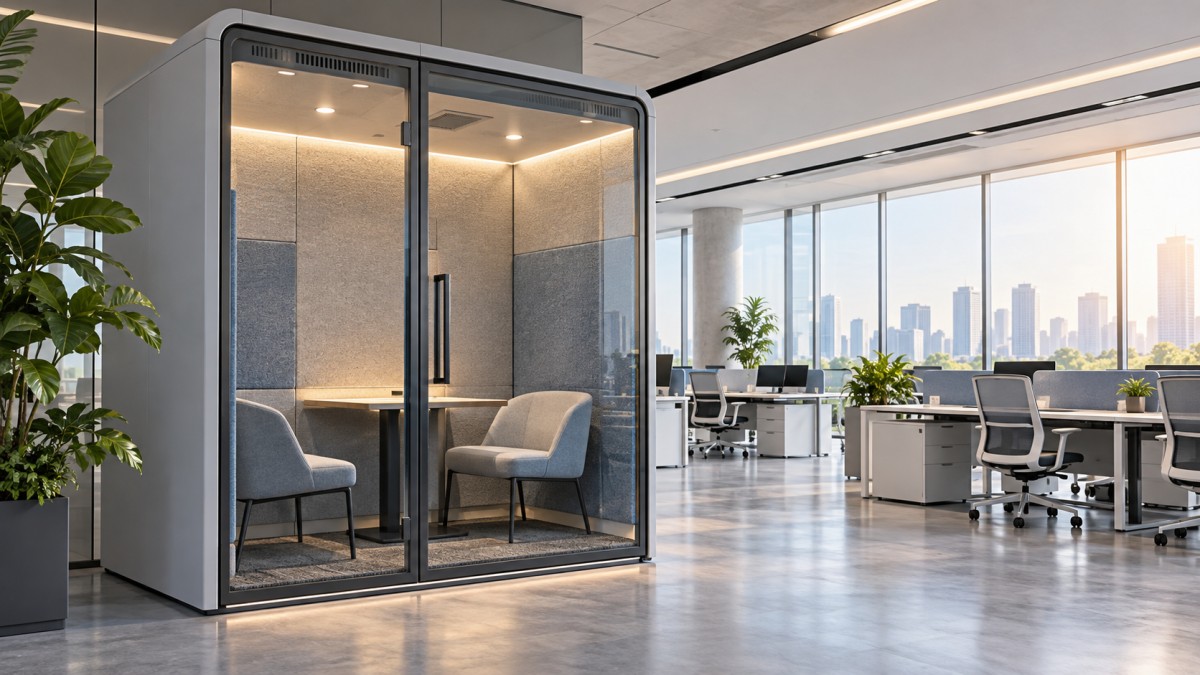
For technical evaluators, comparing phone booths for offices requires more than checking dimensions and finishes. Acoustic performance must be measured, documented, and matched to workplace risks.
A stated decibel figure alone does not prove confidentiality or speech privacy. Buyers should identify what was tested, how it was tested, and which real-world condition applies.
The practical decision is straightforward: specify a booth using transparent acoustic evidence, then validate whether its performance suits conversations, occupancy patterns, and surrounding noise levels.
Start With the Acoustic Outcome You Need
Different office activities demand different results. A quiet focus session, a customer call, a disciplinary discussion, and a financial review should not share identical acoustic requirements.
For ordinary calls, reducing speech distraction may be sufficient. For sensitive discussions, buyers need stronger attenuation, dependable sealing, and careful consideration of sound leakage through ventilation paths.
Technical teams should first define the outside-to-inside and inside-to-outside performance required. These are related outcomes, but they answer different operational questions.
Outside-to-inside isolation determines whether occupants can work without nearby conversations disrupting concentration. Inside-to-outside isolation determines whether people outside can understand private speech within the enclosure.
Speech intelligibility matters more than absolute loudness for confidentiality. Even moderately reduced speech can remain understandable when the listener is nearby or background office noise is low.
Document the intended use cases before requesting quotes. This prevents suppliers from recommending a product whose rating appears impressive but does not address the actual privacy requirement.
Understand What a Noise Reduction Rating Actually Means
Manufacturers often describe a booth as delivering a particular noise reduction value, usually expressed in decibels. That number needs context before it can support a procurement decision.
A reduction of 28 to 30 dB can materially reduce conversational disturbance in an open office. However, it should not automatically be interpreted as total soundproofing.
Decibels are logarithmic, so changes are meaningful. Yet the perceived result also depends on frequency, source loudness, room reverberation, listener distance, and the booth installation location.
Low-frequency sounds from building services, heavy footsteps, or nearby equipment are especially important to assess. Many structures attenuate midrange speech more effectively than bass-dominant noise.
Ask whether the stated value is an overall single-number result, an average across frequency bands, or a result calculated using a named method. Avoid accepting undefined claims.
Also request clarification on directionality. A rating measured for sound entering the booth may differ from the attenuation achieved when speech originates inside and travels outward.
When evaluating phone booths for offices, technical buyers should treat the decibel value as one specification within a complete acoustic package, rather than a standalone buying criterion.
Ask Which Test Method Produced the Rating
Reliable specifications begin with independent, repeatable test evidence. Request the complete test report, not only a marketing summary or a statement that testing was completed.
The report should identify the laboratory or institute, test date, product configuration, measurement positions, testing environment, and applicable standards or technical procedures used.
Laboratory testing can provide useful comparative data because conditions are controlled. Field testing adds value by showing how the booth performs after placement in an active workplace.
Check whether tested materials, glazing, doors, seals, ventilation modules, and electrical penetrations match the quoted configuration. Small construction changes can materially affect acoustic performance.
A report from SGS or an acoustics institute provides more confidence when it clearly identifies the tested model and result. Certification names alone are insufficient without traceable documentation.
Ask suppliers whether the test examined airborne sound insulation, speech privacy, absorption inside the pod, or a combination. These terms describe different acoustic properties and should not be conflated.
Internal absorption reduces echo and improves call quality for occupants. It does not by itself demonstrate that speech will be adequately contained from people outside the booth.
Inspect the Details That Commonly Cause Sound Leakage
Sound insulation performance depends on continuity. Gaps around doors, glass interfaces, cable entries, floor transitions, and ventilation openings can undermine otherwise substantial panel construction.
Door seals deserve close attention because users open and close them repeatedly. Evaluate seal compression, latch alignment, threshold construction, durability, and whether replacement parts are available.
Glazed sections allow visibility and daylight, but their construction matters. Laminated acoustic glass generally performs differently from ordinary tempered glass of a similar apparent thickness.
Ventilation is another critical path. A booth needs adequate fresh-air exchange, but airflow routes require acoustic treatment to avoid creating a direct channel for speech transmission.
Request airflow capacity, fan noise data, operating modes, and the method used to control noise through ducts or vents. Quiet ventilation supports both comfort and privacy.
The TB-M-2 2-4 Person Office Pod illustrates the type of specification buyers should review closely, including laminated 5mm+1.13mm+5mm glass and a third-generation fresh-air exchange system.
For this category, published 28 to 30 dB noise reduction should be reviewed alongside its test report, door construction, material stack, and installed ventilation behavior.
Evaluate the Booth in Its Intended Office Environment
A booth cannot be evaluated independently from its host office. Open-plan layouts, ceiling height, hard surfaces, nearby meeting zones, and mechanical systems influence perceived privacy.
Locate booths away from printer stations, kitchen areas, circulation pinch points, and loud collaboration zones where possible. Placement cannot replace insulation, but it can reduce unnecessary acoustic pressure.
Measure representative background noise during busy periods. Low ambient sound can make residual speech easier to understand, while high background noise may compromise calls inside the booth.
Consider speech masking only as a supplemental strategy. Properly designed masking can improve privacy outside a booth, but it should never compensate for weak enclosure design.
Test real scenarios during an onsite demonstration. Use normal and raised speaking voices, place listeners at realistic distances, and assess whether words remain understandable rather than merely audible.
Include adjacent occupants in the evaluation. A booth that feels quiet to its user may still create distraction outside if speech emerges through gaps, glass, or ventilation components.
Compare Capacity, Internal Volume, and Acoustic Comfort
Capacity affects both workflow and acoustics. A two-to-four-person pod needs enough volume for breathing comfort, meeting furniture, natural movement, and effective internal sound absorption.
Overcrowding creates louder voices and reduces meeting quality. Confirm usable internal dimensions rather than relying solely on external dimensions, especially where sofas, tables, or equipment are installed.
Technical evaluators should compare occupancy claims against meeting behavior. Two people conducting confidential calls may require different space and acoustic expectations than four people holding a short project discussion.
Internal finishes influence reverberation and voice clarity. Absorptive wall panels, carpet, and upholstered seating can reduce reflections, making conversations more intelligible for participants without increasing vocal effort.
Lighting, power access, and controls also influence real use. Users are more likely to close the door and remain inside when the booth is comfortable, functional, and easy to operate.
For example, presence-based lighting and adjustable ventilation controls help reduce energy use while maintaining an acceptable user experience across short calls and longer private meetings.
Build a Procurement Checklist Around Evidence
Request a model-specific acoustic report with the rating, test method, laboratory identity, date, and configuration clearly stated. Treat undocumented performance claims as unverified information.
Confirm whether the quoted rating concerns sound entering, sound leaving, or both directions. Ask for frequency-band data when low-frequency office noise is a meaningful concern.
Inspect the door, seals, glazing, ventilation routes, electrical penetrations, and joints. Require confirmation that the delivered product matches the configuration used for the submitted test evidence.
Evaluate fan noise, fresh-air capacity, thermal comfort, and lighting controls during an occupied demonstration. Acoustic privacy will fail operationally if users avoid the booth because it feels uncomfortable.
Review installation responsibilities, floor requirements, mobility provisions, maintenance intervals, and replacement components. Poor assembly or degraded seals can reduce performance after the initial handover.
Finally, define acceptance criteria before purchase. These may include documentation review, sample inspection, onsite speech testing, and a clear process for resolving performance discrepancies after installation.
Make Ratings Part of a Defensible Technical Decision
The best phone booths for offices are not simply those with the highest advertised decibel number. They are products supported by relevant evidence and suitable for the intended conversations.
Technical evaluators should connect acoustic ratings with speech privacy, ventilation noise, construction details, workplace placement, and user behavior. That approach produces a specification that can be defended internally.
When buyers ask precise questions about test methods, leakage paths, and real installation conditions, they can select office pods that improve focus while protecting discussions with appropriate confidence.

Get real-time quotes
Interested? Leave your contact details.