
Why Phone Booths for Offices Feel Stuffy and How Ventilation Design Solves It
A phone booth can be acoustically effective and still feel uncomfortable within minutes. The usual reason is not simply “poor air quality.” It is a mismatch between the booth’s small enclosed volume, the heat released by the occupant and equipment, and the amount of fresh air the ventilation system can actually exchange while the booth is occupied.
In phone booths for offices, discomfort complaints commonly appear as warmth, stale odour, humidity, drowsiness, or a sense that the air is “heavy.” These symptoms may occur even when the fan is running and the acoustic door seals correctly. The practical issue is whether the system maintains a stable airflow path from intake to exhaust under real operating conditions—not whether its components appear functional during a quick visual inspection.
Why a small booth becomes uncomfortable so quickly
A single-person booth has a limited internal air volume. Once the door closes, an occupant adds heat, moisture and carbon dioxide continuously. A laptop, external display, charging adapter and ceiling light add further thermal load. In a compact enclosure, those loads change the interior condition much faster than they would in an open office.
Carbon dioxide is not the only indicator of comfort, but rising concentrations can align with complaints of sluggishness or stale air when outdoor-air replacement is inadequate. Temperature and humidity can become equally important. A booth may technically exchange air yet still feel warm if it recirculates warm indoor air, if the incoming air is restricted, or if the airflow is too weak to remove heat from the occupied zone.
The enclosure itself makes these issues more visible. Sound insulation relies on continuous panels, sealed door edges, laminated glazing, dense absorptive layers and carefully treated joints. Those same features reduce uncontrolled air leakage. That is necessary for acoustic performance, but it means ventilation cannot rely on incidental gaps around doors or panels. Air movement must be deliberately designed and maintained.
Ventilation capacity is not the same as usable airflow
A fan nameplate, or even an airflow figure in a product specification, does not confirm that the booth is receiving its intended ventilation rate. Installed performance depends on resistance throughout the system. Filters gradually load with dust; grilles can be obstructed; flexible ducts may kink; a loose acoustic baffle may shift; and incorrect replacement parts can change pressure loss substantially.
Airflow also drops when the intake and exhaust paths are poorly balanced. If the exhaust fan is stronger than the available intake path, the booth can develop excessive negative pressure. The door may feel harder to open, and air may enter through unintended leakage paths. If supply dominates exhaust, warm, moist air may remain trapped in upper areas or push through seals. Neither condition guarantees occupant comfort.
The key question is not “Is the fan on?” It is: Where does air enter, where does it travel, and where does it leave when someone is seated and working? A functioning fan can still short-circuit airflow if supply air enters near an exhaust opening and exits before passing through the breathing zone. This leaves the occupant in a pocket of warmer, more stagnant air.
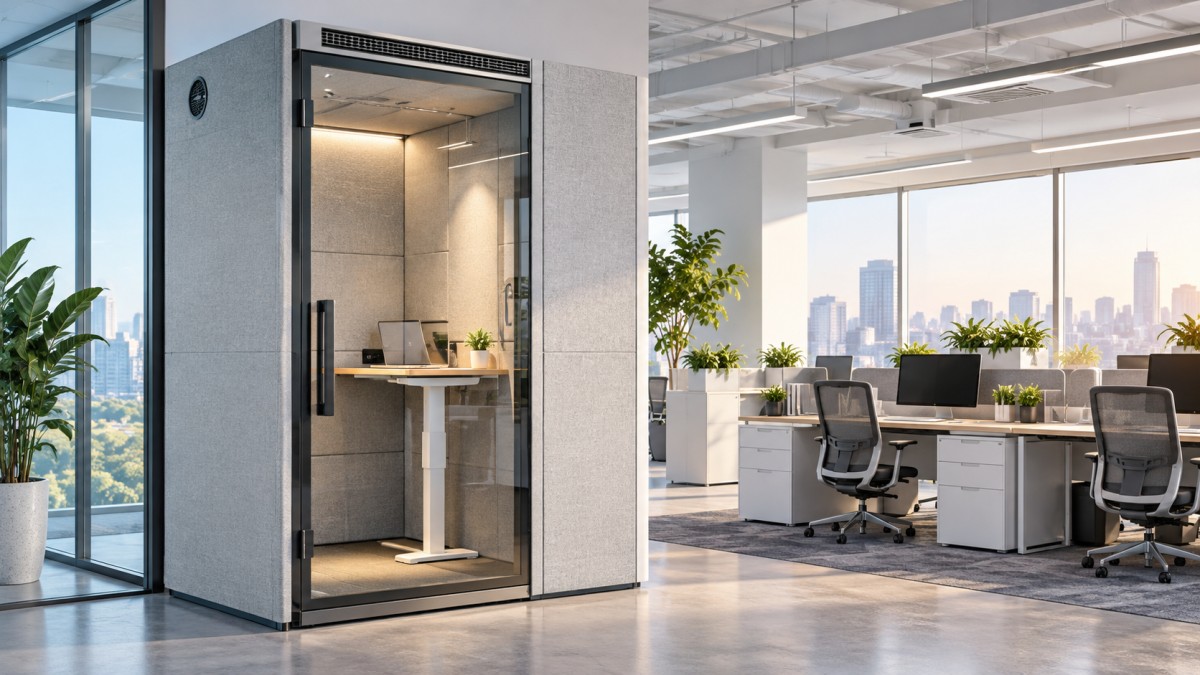
The airflow path matters as much as the fan
Effective booth ventilation needs a complete path: a protected intake, a route through the enclosure, and an exhaust point positioned to remove used air and accumulated heat. In many compact booths, placing supply and extract openings at different elevations or on separated surfaces helps reduce short-circuiting. The exact layout varies by design, but the principle remains consistent: fresh air should sweep the occupied space rather than take the shortest path between two openings.
Acoustic treatment complicates this arrangement. A direct open vent is a potential sound leak, so quiet booths often use lined channels, internal baffles, labyrinth paths or acoustically treated plenums. These elements reduce transmitted noise, but they also add static pressure. If a replacement fan is selected only for low sound output and not for its ability to overcome the system resistance, delivered airflow may be inadequate.
This is why an apparently sensible “quieter fan” substitution can create a comfort problem. The correct replacement must match electrical requirements, control compatibility, operating duty and pressure-flow characteristics. A fan that moves sufficient air in free air may perform poorly once connected to filters, acoustic channels and protective grilles.
Heat complaints should be separated from air-quality complaints
“Stuffy” is often used for several different conditions, and treating all of them as filter problems leads to unnecessary service calls and missed faults.
- Warm but not stale: Check lighting load, electronics, solar gain through glazing, nearby HVAC supply conditions and fan heat. A booth located in a warm corner of the office starts with a disadvantage.
- Stale or sleepy feeling: Verify fresh-air exchange, intake blockage, exhaust operation, control timing and the possibility of airflow short-circuiting.
- Humid or odorous interior: Inspect for low extraction, contaminated filters, damp acoustic materials, poor cleaning practices or odours drawn in from the surrounding office.
- Intermittent discomfort: Investigate occupancy sensors, delayed fan start, programmed shutdown settings, loose power connections and controls that behave differently after a period of use.
Temperature readings alone do not settle the issue. A booth can be within a reasonable temperature range yet feel uncomfortable because air velocity is too low or because exhaled air is not being displaced effectively. Conversely, a strong but poorly directed air stream can create drafts while leaving upper-level heat trapped inside the enclosure.
Controls can create faults that look mechanical
Many office booths use presence sensors to activate lighting, ventilation or both. This reduces energy use during vacant periods, but it introduces a control dependency. A sensor may detect entry reliably while a relay, controller setting or fan-speed command fails to activate as intended. In other cases, the fan begins only after an unacceptable delay, or stops too soon when an occupant remains still during a call.
Service inspection should therefore include the operating sequence, not only the physical hardware. Enter the booth, close the door, observe whether the fan starts, listen for changes in speed, and verify that the system remains active through a realistic occupied interval. Test exit delay separately. Lighting and ventilation may be tied to the same sensor but controlled through different circuits or settings.
Booths with touch controls require an additional check: a user-adjustable setting may have reduced lighting or fan operation without producing a visible fault indication. Restoring a default configuration may be appropriate only after confirming the approved operating settings and ensuring that no underlying electrical or control issue is being masked.
Acoustic sealing should not be “fixed” by creating air leaks
When occupants complain about heat, it can be tempting to loosen a door seal, remove a grille insert, enlarge an opening or leave service panels slightly unlatched. These actions may produce a short-term perception of better airflow, but they compromise acoustic isolation, introduce rattles, and make performance unpredictable. They can also draw dust into locations not designed for filtration.
The right remedy is to restore the engineered ventilation path. That means cleaning or replacing filters with approved equivalents, clearing grilles, checking duct integrity, confirming fan orientation, inspecting baffles for displacement, and verifying that acoustic seals remain continuous. If airflow remains insufficient after these checks, the limitation may be a system-design or installation issue rather than a maintenance issue.
For example, a booth positioned tightly against a wall may have its intake or exhaust clearance reduced. A renovation may alter room pressure relationships. Nearby return-air grilles, high-output printers, pantry areas or local heat sources can affect what the booth draws in. The enclosure may be operating exactly as built while the surrounding installation conditions have changed.
A practical inspection sequence
Start with the complaint pattern: whether it occurs immediately after entry, after a particular duration, at certain times of day, or only in one location. That information helps distinguish a booth-specific problem from a building HVAC condition.
Then inspect the airflow route from outside to inside and back out again. Check exterior grilles, filter condition, fan operation, internal openings and exhaust outlets. Listen for unusual fan noise, which can indicate bearing wear, blade contact, loose mountings or obstruction. Verify that acoustic lining and baffles are intact rather than sagging into the air path.
Where permitted by site procedures, measure conditions instead of relying only on subjective reports. Temperature, relative humidity, carbon dioxide trends and air velocity readings can help identify whether the issue is inadequate exchange, poor distribution or excessive heat gain. Measurements are most useful when taken with the booth occupied and the door closed, because open-door readings do not represent normal operation.
A compact model such as the TB-SH Height Adjust Acoustic Pod illustrates why this discipline matters. Its enclosed internal dimensions, sound-insulating construction and third-generation fresh-air exchange system are designed to work together. The ventilation system should be assessed as part of that complete acoustic enclosure, not as an isolated accessory. Altering one element without considering pressure resistance, sealing and control behaviour can reduce comfort or acoustic performance elsewhere.
When maintenance cannot solve the underlying issue
Some comfort complaints point to a need for engineering review rather than routine servicing. Repeated overheating despite clean filters and verified fan operation may indicate inadequate airflow capacity for the actual thermal load. Persistent stale air with normal fan sound may indicate a blocked or poorly routed path. Complaints limited to one installation location may reflect the building’s HVAC balance, ambient temperature or insufficient clearance around the booth.
The useful handover record is not merely “fan checked.” It should identify filter condition, measured or observed airflow direction, sensor response, operating duration, room conditions, booth location and any changes made nearby. That record makes recurring issues traceable and prevents repeated replacement of parts that were never the source of the problem.
A quiet booth is not comfortable because it is sealed; it is comfortable because its sealing and ventilation are engineered as one system. Maintaining that balance protects the reason the booth was installed in the first place: a private space that supports concentrated work and calls without becoming an uncomfortable enclosed box.

Get real-time quotes
Interested? Leave your contact details.